

How to transition data analytics from a one-off project to a continuous engine of transformation and business impact.
1. Output is not the same as outcome. Confusing the two can be costly
A Data Analytics team can deliver everything that was requested and still fail to generate value for the business. A dashboard may be published, a model may be in production, and an artificial intelligence solution may be functioning correctly from a technical standpoint; however, if no decisions have been improved, no behavior has changed, and no relevant results have been impacted, it’s worth asking: what, in fact, has been transformed?
This is an especially important question for departments that have long equated success with the ability to deliver. In this context, distinguishing between output and outcome ceases to be merely a conceptual discussion and becomes a matter of value creation, because delivering a solution does not necessarily mean producing the expected effect on the business.
The problem, therefore, does not lie in the delivery itself, but in treating it as the end goal. The maturity of data analytics has historically been associated with the ability to produce more dashboards, models, pipelines, automations, and, more recently, artificial intelligence use cases. All of this capability remains essential, since there can be no scale without engineering, architecture, data quality, and reliable models. Still, technical delivery only translates into value when it begins to influence decisions, processes, and concrete results.
Therefore, it is important to recognize that a published dashboard does not, in and of itself, represent a better decision; similarly, a model in production does not guarantee that it will actually be used, just as a functioning AI solution does not mean that the process to which it is connected has changed.
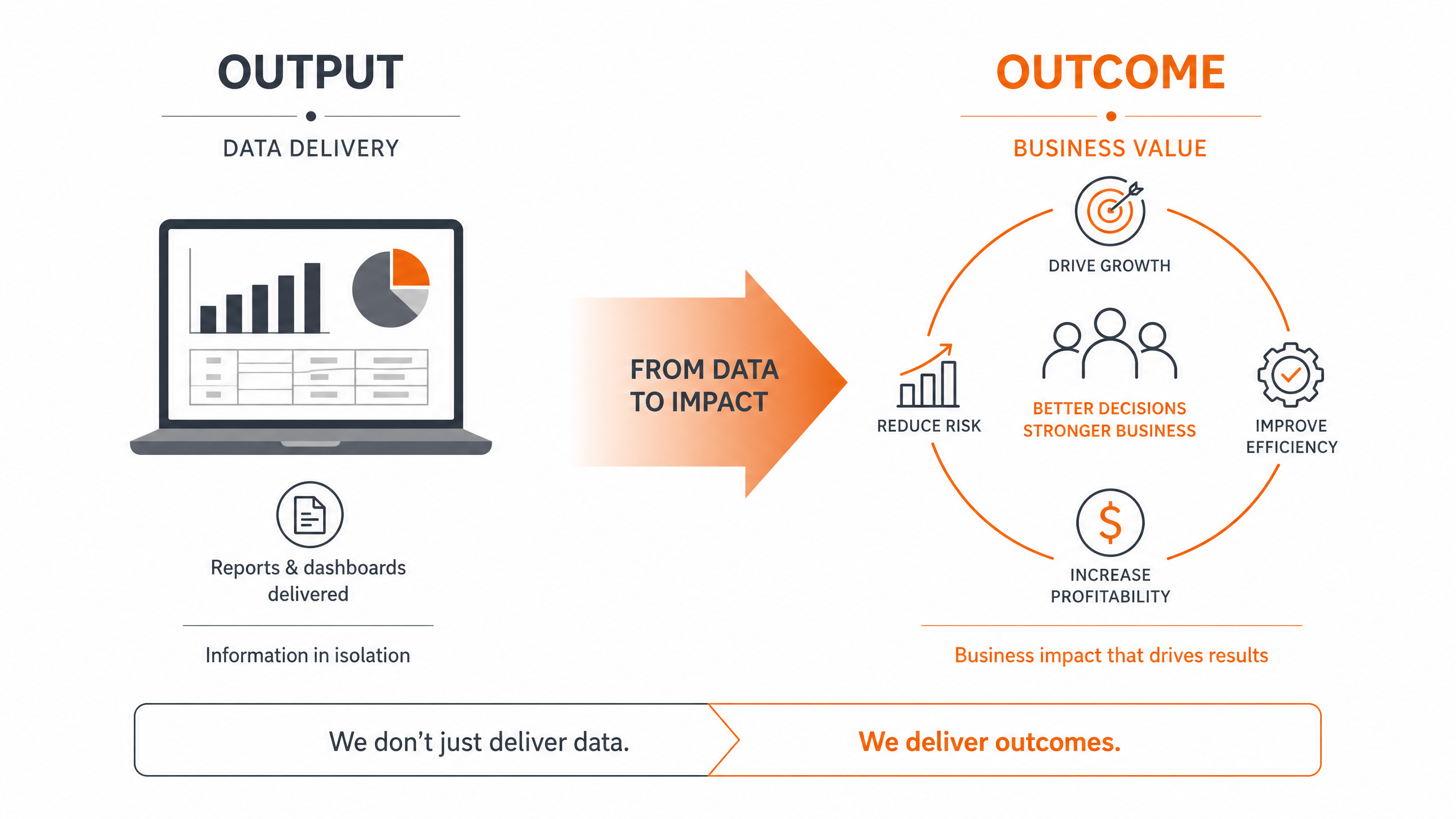
From technical delivery to business impact: the value of data analytics begins when the output becomes an outcome
Deployment, therefore, should not be seen as the end of the journey, but rather as the beginning of the proof of value. It is from this point on that it becomes possible to assess whether the solution has been adopted, whether it has become part of the decision-making process, and, most importantly, whether it has contributed to bringing about the change that justified its creation.
This perspective aligns with Gartner’s recommendations regarding the need to measure and manage the performance of Data & Analytics based on the value generated for the business, rather than solely on the execution or completion of technical deliverables.
Reference: Gartner. How to Measure and Manage Data & Analytics Business Performance. 2024.
2. Data shouldn’t just be near the data
Another important change to maximize the value of data analytics is to bring the field closer to the contexts where decisions actually take place. Instead of launching an initiative by asking which technology should be used, the starting point should be to understand which business problem needs to be addressed and, most importantly, which decision needs to be improved so that this problem can be resolved.
This logic is supported by researchers at MIT Sloan, who argue that analytics programs tend to lose effectiveness when they are guided primarily by available data and the technical possibilities for analysis, rather than by strategic objectives and the decisions the business needs to make. When technology comes first, there is a risk of seeking out problems that justify its application; when the problem comes first, it becomes possible to assess more clearly which intervention makes sense, whether it is based on analytics, artificial intelligence, process change, or even a solution that does not rely on technology.
This perspective also requires a reevaluation of how requests reach the data teams. A long backlog is not necessarily a sign of relevance or maturity. When every request is automatically turned into a project, the department tends to optimize its capacity to fulfill requests, rather than focusing its efforts on initiatives with the greatest potential for impact. In this context, maturity has less to do with the ability to say, “Yes, we can build it,” and more to do with the quality of the questions asked before any development begins.
Some of these questions are fundamental: What problem does this request aim to solve? What decision will be different as a result of this solution? How will we know if it has actually been adopted? What outcome do we hope to influence? And, perhaps most importantly, should this request even exist?
By incorporating this type of questioning into the prioritization process, Data Analytics moves beyond merely acting as a recipient of requests and takes on a more consultative role, participating in defining problems and shaping the decisions that truly matter to the business.
Reference: MIT Sloan Management Review. “Decisions, Not Data, Should Drive Analytics Programs.”
3. The transformative model and the value chain
If the goal of data analytics is to generate value for the business, the operational approach must go beyond the traditional flow of Demand → Development → Delivery → Closure. This model may adequately organize execution, but it does not necessarily track what happens after delivery—precisely where value begins to be demonstrated.
A more comprehensive way to structure this journey is to think of a value chain consisting of six stages:
- Relevant Problem
- Hypothesis
- Experiment
- Adoption
- Decision
- Behavior and outcome
This sequence expands the role of Data Analytics by linking the development of the solution to the change it aims to bring about. The process no longer begins solely with a request but starts with the definition of a relevant problem, followed by the formulation of a testable hypothesis. In this context, the technical delivery becomes part of an experiment whose value can only be confirmed when there is adoption, influence on decisions, and, consequently, a change in behavior or outcome.
As a result, the data team begins to participate more actively in defining the problem, while business units take on an equally important role in adopting and implementing the solution. Success, therefore, is no longer measured solely by deployment but is instead evaluated by the ability to transform a delivery into tangible impact.
4. The real test begins after deployment
When a solution goes into production, the discussion about value does not end; in practice, that is when it becomes most important. After deployment, the focus must shift from what was built to what is actually happening in operations.
Four questions help guide this monitoring: Has the solution been adopted? Has the decision changed? Has behavior changed? Has the outcome changed?
These questions form an important sequence. When there is no adoption, the solution has not become part of the routine. When the solution is being used but no decisions have changed, it’s possible that it has not yet been integrated into the decision-making process. If the decision changes but behavior remains the same, there may be operational, cultural, or organizational barriers preventing the change from taking place. And if behavior changes without the expected outcome materializing, it is necessary to reconsider the very hypothesis that guided the initiative.
This logic transforms data analytics into a continuous learning process, in which each implementation produces evidence that guides the next decision. Instead of a linear sequence that ends with delivery, we begin working within a cycle of delivery, adoption, decision, behavior, outcome, and learning, allowing solutions to be adjusted as their actual impact becomes known.
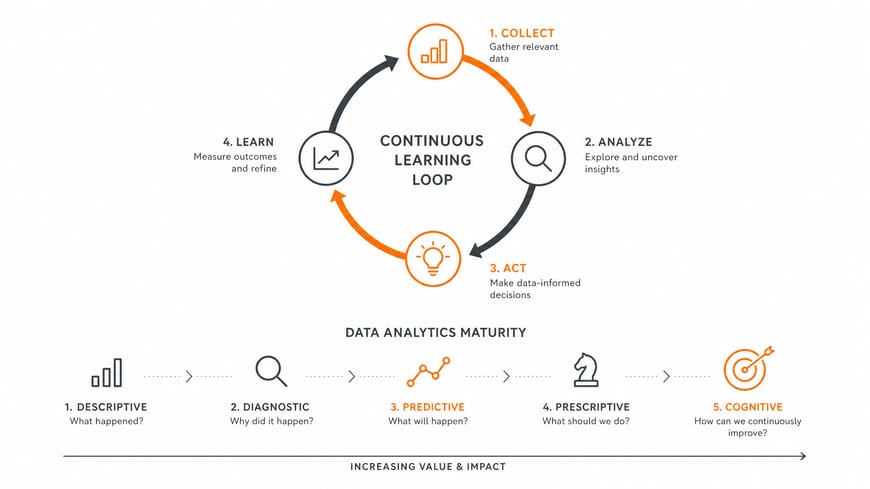
Capturing value requires a continuous cycle of adoption, decision-making, action, measurement, and learning.
5. AI and the Challenge of Capturing Value
Artificial intelligence makes this discussion even more relevant. As developing and deploying new solutions becomes faster and more accessible, the main challenge shifts from merely the technical ability to build them to the ability to integrate these solutions into operations, drive process changes, and transform technology into tangible business value.
This scenario is also reflected in McKinsey’s research. In 2025, the consulting firm noted that AI adoption had already reached 78% of respondents, while more than 80% still reported no tangible impact on EBIT. This data underscores a fundamental distinction: expanding the use of AI does not, in and of itself, mean capturing value from it. Between the implementation of a solution and its financial or operational impact lies a critical phase involving adoption, integration into processes, and changes in the way people work and make decisions.
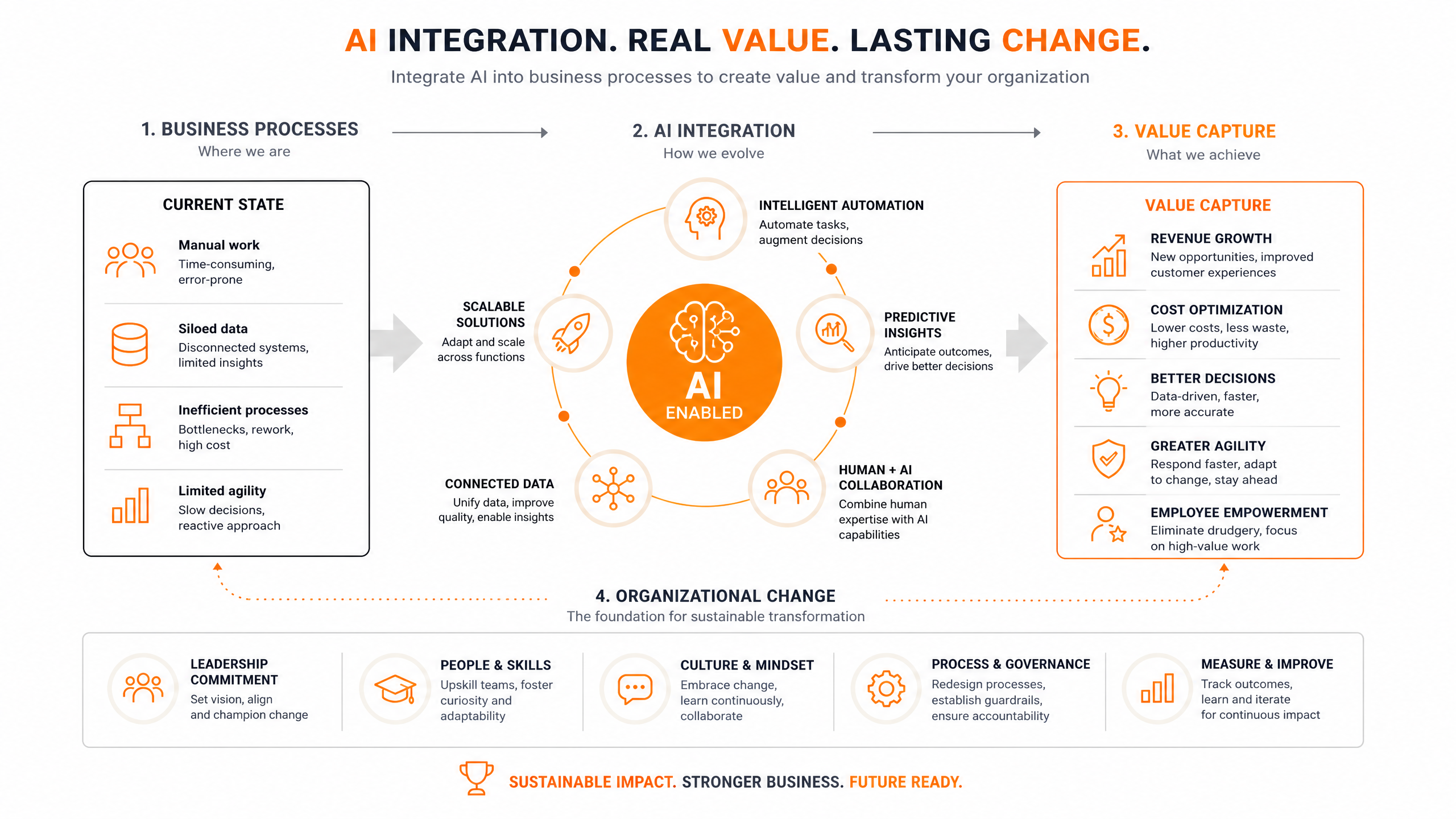 Reference: McKinsey & Company. The State of AI: How Organizations Are Rewiring to Capture Value. 2025.
6. A Framework for Measuring Value in Data Analytics
A simple way to assess whether a data analytics initiative is, in fact, generating value is to track its progress across six dimensions:
- OUTPUT: What did we deliver?
- ADOPTION: Was the solution actually used?
- DECISION: Have any decisions started to be made differently?
- BEHAVIOR: Did the solution bring about a change in behavior?
- OUTCOME: Was there a concrete impact on any results?
- LEARNING: What did this experience reveal, and how should these lessons guide the next decision?
This framework helps shift the assessment of success from the mere completion of a deliverable to the transformation it can bring about. A dashboard, an analytical model, or an artificial intelligence solution are means of generating value—not the value itself. The result emerges when these capabilities contribute to better decisions, more efficient processes, risk reduction, increased revenue, behavioral change, or even the elimination of a significant problem.
7. The next level of data analytics isn’t about producing more. It’s about transforming better.
The evolution of data analytics will not be determined solely by the ability to build more sophisticated dashboards, more accurate models, or more advanced artificial intelligence solutions. These elements will remain fundamental, but they are no longer sufficient to define success.
The true leap in maturity occurs when the field stops asking only “what do we need to deliver?” and starts asking “what needs to change?” This shift in perspective also redefines the role of data teams, which move beyond acting solely as solution providers to take a more active role in defining problems, identifying decisions that need improvement, and determining the desired outcomes.
For this to happen, technology and business must share responsibility for the value generated. A Data Analytics department can build a technically excellent solution, but capturing value depends on its adoption, integration into processes, the ability to influence decisions, and continuous learning from the results produced.
In a landscape where Artificial Intelligence makes it increasingly fast and accessible to create new solutions, this distinction becomes even more relevant. The competitive edge will not lie solely in who can build it first, but in who can transform technological capability into real business change.
Perhaps, therefore, the primary measure of maturity in a Data Analytics department lies not in the number of projects delivered, but in its ability to improve decisions, transform behaviors, and generate value on an ongoing basis. Because deployment may mark the end of a solution’s development, but it is precisely from that point that the creation of its value begins.
7. Bibliography
1. Gartner. How to Measure and Manage Data & Analytics Business Performance. 2024.
2. Gartner. A Journey Guide to Realizing Value from Data, Analytics, and AI. 2024.
3. Gartner. Improve Decisions by Establishing Value Stream Collaboration. 2024.
4. MIT Sloan. Decisions, not data, should drive analytics programs.
5. McKinsey & Company. The State of AI: How Organizations Are Rewiring to Capture Value. 2025.
6. McKinsey & Company. The State of AI in Early 2024: Gen AI Adoption Spikes and Begins to Generate Value. 2024.