
The Three Leverage Points for Building Better Systems with LLMs
Before switching models or starting to fine-tune, learn how to diagnose the problem using...


An overview of the AWS architecture, hybrid squads, and what changes when agents begin participating in the development cycle.
Artificial intelligence is transforming software development far beyond code assistants. Developers are already able to interpret requirements, draw up plans, modify artifacts, run tests, and interact with tools. But this evolution raises a question more important than simply measuring how much faster we can code:
If execution speeds up, can our organization decide, validate, and learn at the same pace?
It is in this context that the AI-Driven Development Life Cycle—AI-DLC—emerges. In this article, the term refers to the approach proposed by AWS: a way of organizing the cycle in which AI participates in different parts of the work, while people remain responsible for outcomes, risk, and relevant decisions.
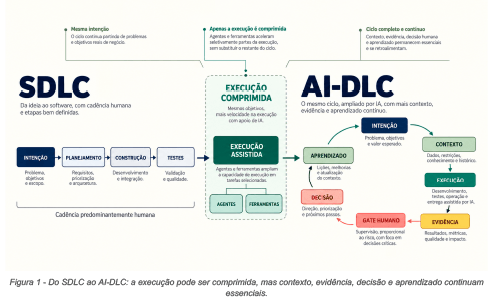
For decades, we’ve organized development around the SDLC: understanding a need, planning, building, testing, deploying, and operating. The AI-DLC doesn’t eliminate this logic. It primarily changes how certain parts of the process unfold.
As execution speeds up, other capabilities take on greater importance: intent, context, verification, decision-making, and learning. Therefore, the AI-DLC should be viewed as an evolution of the cycle—not as a complete break from it.
In the current open implementation by AWS Labs, the AI-DLC organizes the cycle into five phases. The scope determines which stages will actually be necessary.
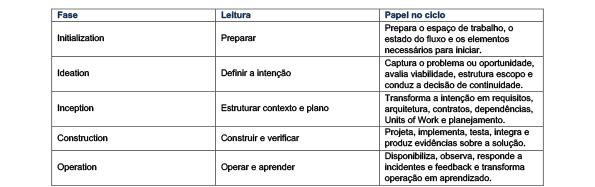
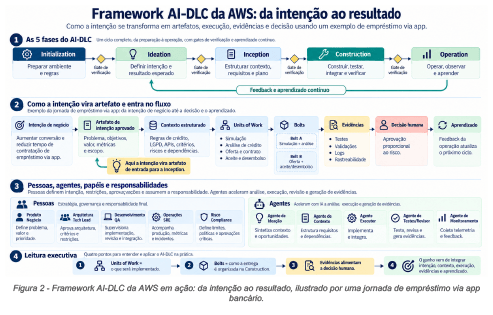
There are verification gates between the main boundaries of the flow, and at the end of Operation, feedback loops back to Ideation. In simple terms, the cycle is: prepare -> define intent -> structure context and plan -> build and verify -> operate and learn.
During Inception, the work can be broken down into Units of Work. In Construction, related Units can form Bolts, allowing smaller, traceable parts of the execution to progress according to their dependencies.
The important point isn’t the names. It’s realizing that AI participates in the execution, but the work remains dependent on clear context, criteria, evidence, and decisions.
An example of a loan journey via an app helps make the framework more concrete. The business intent —for example, improving conversion and reducing the time to approval—ceases to exist merely as an idea and becomes an input artifact with a problem, objectives, metrics, and scope.
This artifact feeds into Inception. There, credit rules, APIs, regulatory restrictions, architecture, acceptance criteria , risks, and dependencies form the structured context. Next, the work is broken down into Units of Work and organized into Bolts for execution in Construction.
Tests, validations, logs, and traceability are produced as evidence. This evidence informs human decisions proportional to the risk. In Operation, telemetry and feedback feed back into the cycle and update the context for upcoming decisions.
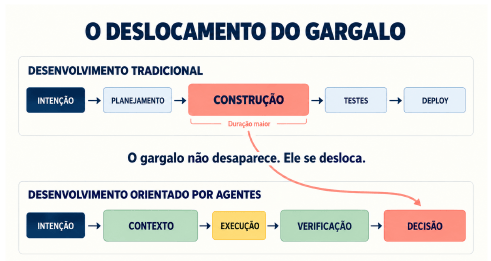
The bottleneck does not disappear. It shifts.
DORA reported that 90% of technology professionals surveyed in 2025 used AI at work, and more than 80% saw an increase in productivity. Still, productivity gains do not automaticallymean shorter delivery times.
In an experiment with 95 professional developers, GitHub observed a 55% faster completion time for a specific task using Copilot. METR, however, in a different context, found a 19% increase in time among 16 experienced developers performing 246 real-world tasks. The results show that there is no universal gain: productivity depends on the task, tools, experience, and the work system surrounding AI.
As development accelerates, time and effort may be redirected toward context understanding, review, testing, security, integration, and decision-making.
The bottleneck does not disappear. It simply shifts.
At Agile Trends São Paulo 2026 and FEBRABAN TECH 2026, AI-DLC took center stage in discussions about agent-driven development. Major companies in the financial sector presented a vision of hybrid squads composed of humans and AI agents.
In this model, humans remain responsible for context, judgment, and decision-making, while agents focus on execution and connecting artifacts throughout the workflow.
Another point discussed was the risk that human approvals themselves could become the next bottleneck. In response, the concept of MOB was introduced: bringing together, at the necessary moment, the people with the knowledge and authority to make decisions quickly, thereby avoiding lengthy approval queues.
This message aligns with the logic of AI-DLC: local speed only translates into results when the entire system keeps pace with the new execution capability. It is not enough to accelerate development if context, validation, governance, and decision-making continue to operate at the same pace.
must provide clear answers: What problem are we solving? What outcome do we expect? What constraints must be respected? How will we know the solution is correct? When should AI pause and request a human decision?
In this scenario, requirements, architecture, policies, acceptance criteria, and decisions are no longer merely supporting documentation. They become an integral part of the execution infrastructure.
This is perhaps one of the most significant organizational impacts of AI: making explicit the knowledge that for years remained scattered across meetings, documents, and people.
Not every change should be granted the same level of autonomy. Small, reversible, and low-impact changes may allow for greater automation. Changes related to security, sensitivedata , transactions, or critical environments require different controls.
Therefore, the question should not be “Can we allow agents to work on their own?” but rather “What level ofautonomy is acceptable for this change, given its risk?”
It’s also important to distinguish between the autonomy to execute and the authority to implement or drive a change. “Human-in-the-loop” doesn’t mean having people approve everything. It means applying humanjudgment where it actually changes the outcome.
If AI produces more code, features, or pull requests, measuring only volume can create a misleading impression of productivity. Speed is a system variable; outcome is the goal.
In addition to throughput, organizations need to track stability, quality, and risk; governance; cost; review time; and team sustainability. The central question shifts from “How much software do we produce?” to “How quickly do we turn an intention into a proven result?”
DORA describes AI as an amplifier of an organization’s existing capabilities. Best practices can be enhanced, but so can weaknesses.
Therefore, simply making agents available does not automatically transform development. Transformation occurs when we are able to organize better:
Intention -> Context -> Execution -> Evidence -> Decision -> Learning
AI can dramatically accelerate execution. But the advantage tends to lie with organizations capable of providing context, verifying evidence, making decisions, and learning at the same speed.
Are we merely accelerating software production, or are we redesigning our ability to turn intent into results?
• AWS Labs AI-DLC Workflows - Phases and Stages -
https://awslabs.github.io/aidlc-workflows/guide/04-phases-and-stages/
• DORA - Balancing AI tensions - https://dora.dev/insights/balancing-ai-tensions/
• GitHub Research - Quantifying GitHub Copilot’s impact on developer productivity -https://github.blog/news-insights/research/research-quantifying-github-copilots-impact-on-developer-productivity-and-happiness/
• METR - Measuring the Impact of Early-2025 AI on Experienced Open-Source Developers -https://metr.org/blog/2025-07-10-early-2025-ai-experienced-os-dev-study/
• DORA - State of AI-Assisted Software Development 2025 - https://dora.dev/research/2025/dora-report/
• OWASP - Secure Coding with AI Cheat Sheet https://cheatsheetseries.owasp.org/cheatsheets/Secure_Coding_with_AI_Cheat_Sheet.html
• Agile Trends São Paulo 2026 - article on hybrid squads and AI agents -https://agiletrendsbr.com/itau-projeta-squads-com-agentes-de-ia-ate-20-vezes-mais-rapidas/
• FEBRABAN TECH 2026—human leadership and autonomous AI—https://febrabantech.com/noticias/febraban-tech-2026-destaca-parceria-entre-ia-autonoma-e-lideranca-humana
Before switching models or starting to fine-tune, learn how to diagnose the problem using...
In just 6 months, Foursys strengthened a financial institution’s security with Zero...
Artificial Intelligence, non-human identities, post-quantum cryptography, the evolving...